How to Find an Event Space in South London
Finding an event space in South London does not have to be difficult. There are many different types of venues available, from community halls and function rooms to cafés and flexible spaces. The main challenge is finding one that suits your guests, budget and plans.
Whether you are organising a birthday party, meeting, workshop, class or community event, it is useful to start with a clear idea of what you need. There can be a lot to remember when planning an event from start to finish, so choosing the venue early can make the rest of the process easier.
Start With Your Event Requirements
Before searching for a venue, think about the basics. How many people are coming? What will you be doing in the space? Do you need tables and chairs? Will you need a kitchen, Wi-Fi, sound equipment or an open area?
For example, a small birthday party may need seating, space for food and some room for activities. A business meeting may need tables, chairs and Wi-Fi, while a dance or fitness class will usually need more open floor space.
Conveenie can make this search easier because you can explore event spaces based on things such as location, price, capacity, amenities and accessibility.
Look Across South London
South London covers a large area, so it is worth looking beyond one neighbourhood.
You could search around places such as Peckham, Southwark, Lewisham, Battersea, Wandsworth, Clapham, Blackheath, Croydon and Sutton. Choosing a venue that is convenient for most of your guests can make travelling easier and may also give you more affordable options.
Conveenie's guide to affordable and versatile venues in London neighbourhoods includes several South London locations, including Battersea, Southwark, Lewisham, Sutton and Croydon.
This is useful because you do not always need to travel into central London to find a suitable event space.
Look at What the Venue Already Offers
Once you have found a few possible venues, compare what is included.
Tables and chairs can be important for parties and meetings. A kitchen can be useful for events involving food. Wi-Fi and audio-visual equipment may be needed for presentations or workshops. You should also check toilets, accessibility and any parking options.
For example, South London Louie in Peckham is listed on Conveenie as a space for up to 50 guests. It has Wi-Fi, kitchen facilities, tables, chairs, toilets and lighting options, making it an example of a flexible local space for different types of gatherings.
Another example is The Garden Room at Appleby Blue in Southwark. It can accommodate up to 100 guests and has an adjoining courtyard and kitchen facilities that can be hired separately. This could suit larger workshops, gatherings or community events.
These are just examples, and the right choice will depend on your own requirements and the date you need.
Think About Your Budget
The venue is often one of the main costs of an event, so it is a good idea to decide on a budget before booking.
Do not only compare the hourly hire price. Think about what you get for that price. A venue with tables, chairs and other useful facilities included may work out better than a cheaper room where you need to hire everything separately.
You can also consider different days and times. If you are flexible, a weekday or quieter period may give you more options and potentially help with your budget.
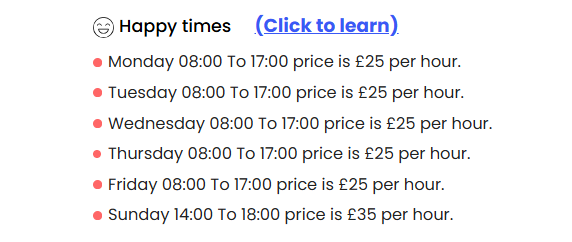
This is also where Conveenie's Happy Times can be useful. Some venues offer discounted rates during selected periods, so checking different booking times may help you find a better option.
Think About Your Guests
The location of your event space should also work for the people attending.
Think about public transport, parking and how easy the venue is to find. If you are inviting families, older guests or people with accessibility requirements, check that the venue is suitable for them.
A local venue can also make things easier for you. If you need to bring food, decorations or equipment, a space that is closer to home can save time and effort.
Ask Questions Before Booking
Once you have found a venue you like, check the details before confirming your booking.
You may want to ask whether you can bring your own food, decorate the space, move tables and chairs or use your own equipment. You should also check when you can arrive to set up and what you are expected to do when the event finishes.
Conveenie allows guests to message hosts about specific requirements and, where needed, arrange to visit a venue before booking.
Asking these questions early can prevent problems later.
Consider Different Types of Spaces
One advantage of searching in South London is that you do not have to limit yourself to traditional event venues.
A community hall may work well for a children's party or family gathering. A function room could be suitable for a birthday or private event. A café might work for a smaller gathering, while a larger community space could be better for a workshop or class.
The best venue is usually the one that fits your event rather than the one that looks the most impressive.
Finding an event space in South London is mainly about knowing what you need and taking the time to compare your options.
Start with your guest numbers, event type and budget. Then look at the location, capacity, facilities and venue rules. It is also worth checking what is already included so you do not end up paying for equipment you do not need.
There are many local spaces to choose from, and Conveenie makes it easier to search and compare community venues across London. The platform covers different types of spaces and allows you to look at practical details before deciding.
Whether you need a small room in Peckham, a community hall in Southwark or a larger space elsewhere in South London, taking a little time to compare your options can help you find a venue that works well for both you and your guests.