blog-img
Dated:Aug 13, 2026

How to Set and Stick to an Event Budget

Planning an event usually starts with the exciting stuff. You think about the venue, the food, the people you want to invite and what you want everyone to do on the day.

Then the costs start adding up. Venue hire, catering, equipment, staff, entertainment and all the smaller expenses can quickly push an event beyond its original budget. That's why event budget planning is worth doing before you start making bookings.

The good news is that you don't need a complicated finance system to keep things under control. A clear budget, a little research and some careful venue planning can go a long way.

Start With Your Total Budget

Before looking at venues or contacting suppliers, decide how much you can really spend.

For a corporate event, you may already have an agreed budget from your company. For a community event or private celebration, you may need to work out the figure yourself.

Whatever the number is, don't plan to spend every penny of it.

Keep a contingency amount aside for things that may come up later. Extra guests, additional equipment, longer venue hire or last-minute changes can all add to the final bill.

Once you have your total, divide it into the main areas of the event. This makes it much easier to see where your money is going.

Work Out Where the Money Needs to Go

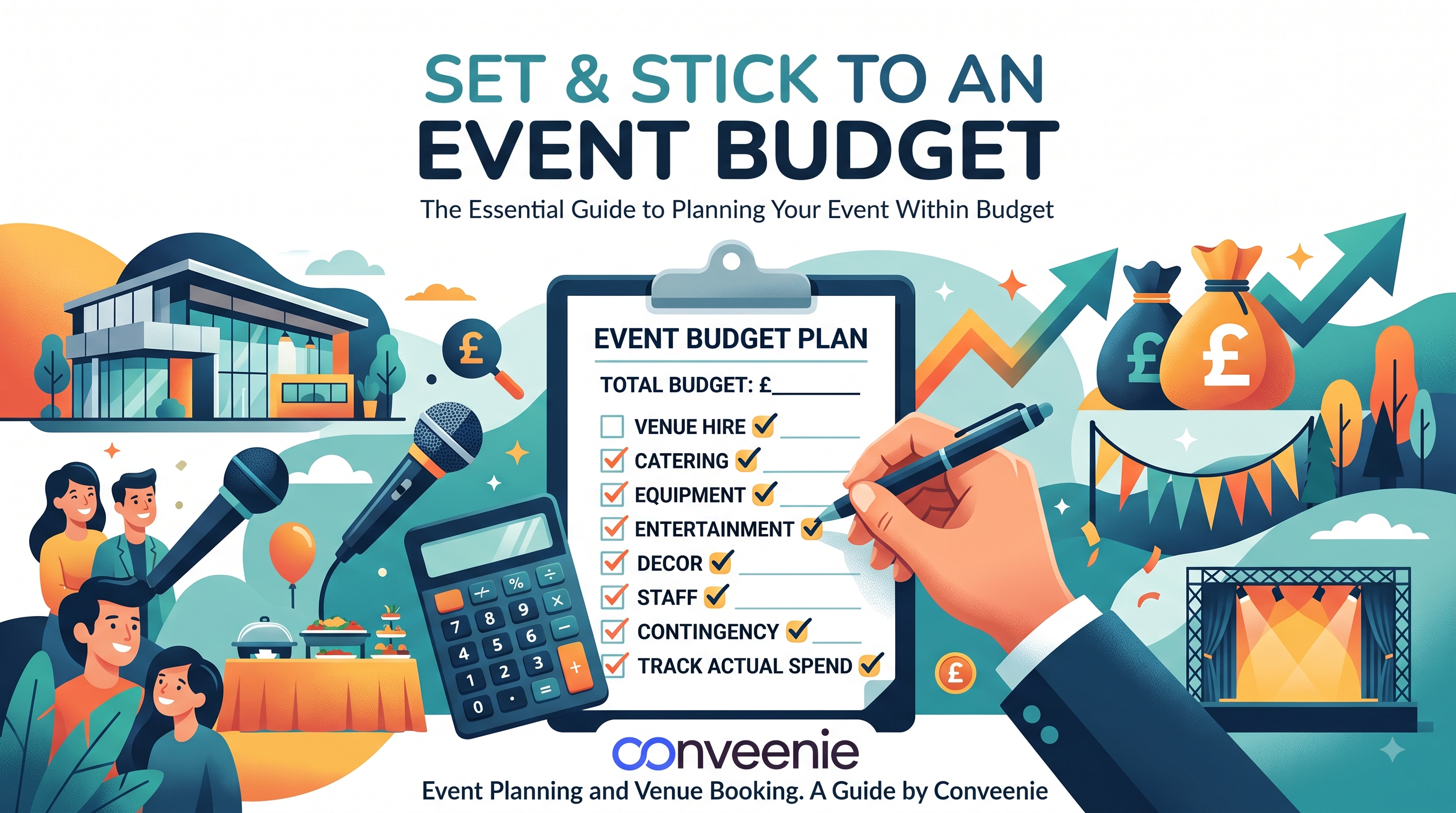
A simple event cost breakdown UK organisers can start with might look like this:

  • Venue hire
  • Catering and refreshments
  • Tables, chairs and other equipment
  • Audio-visual equipment
  • Entertainment
  • Decorations and branding
  • Staff and event support
  • Transport and parking
  • Marketing and printing
  • Insurance or permits, where needed
  • Contingency

You don't need to give every category the same amount.

Think about what matters most for your particular event. A corporate conference may need a larger share of the budget for a suitable venue, presentation equipment and catering. A birthday party might put more towards entertainment and decorations.

The important thing is knowing your priorities before you start spending.

Make Venue Hire Part of Your Budget From the Start

For many events, the venue is one of the biggest costs. It can also affect several of your other expenses.

For example, a venue with tables, chairs, Wi-Fi and AV equipment included could save you from hiring those items separately. A venue that's easy to reach by public transport could also reduce the need to arrange transport for guests.

This is why venue hire budgeting tips shouldn't just focus on the hourly hire rate.

With Conveenie, you can browse different community and event spaces and compare what they offer before deciding which ones are worth considering.

Rather than choosing a venue simply because it has the lowest advertised price, look at the overall value of the hire.

Look at Off-Peak Options

Your event doesn't always need to take place at the busiest time.

If your schedule is flexible, looking at quieter periods can be another way to manage your venue budget.  Conveenie's 'Happy Times' off peak pricing at participating venues, so it's worth checking whether your preferred space has a lower-priced time available.

For example, moving a meeting, workshop or community event to an off-peak slot could leave more money available for catering, equipment or other parts of the event.

The key is to compare the available times rather than automatically choosing the most popular slot.

Don't Forget the Hidden Costs

One of the easiest ways to go over budget is to focus on the main price and forget everything around it.

These hidden event costs UK organisers should check for can include:

  • Extra hours before or after the event
  • Cleaning fees
  • Equipment hire
  • Additional staff or security
  • Delivery and collection charges
  • Catering changes
  • Parking
  • Printing and signage
  • Additional guests
  • Last-minute supplier changes

The same applies when you're looking at venues through Conveenie. Read the venue information carefully and check what is included in the hire before confirming your booking.

If something isn't clear, ask.

It's much easier to clarify an additional charge before booking than to discover it when you're already committed.

Compare What's Included Before You Decide

Two venues can have very different prices but end up costing a similar amount once everything is added.

Imagine Venue A charges £500 but you need to hire £200 worth of equipment separately.

Venue B costs £600 but already includes the equipment you need.

Venue B may actually be the better choice.

This is one reason browsing and comparing spaces on Conveenie can be useful during the planning stage. You can look beyond the headline hire price and consider the type of space, facilities and other details that could affect your final event cost.

You're not necessarily looking for the cheapest venue.

You're looking for the venue that gives you what you need without adding unnecessary costs.

A Simple Corporate Event Budget Template

If you're organising a corporate event, you can keep your corporate event budget template fairly simple.

Category

Estimated Cost

Actual Cost

Venue hire

£

£

Catering

£

£

Equipment / AV

£

£

Staff

£

£

Entertainment

£

£

Marketing / printing

£

£

Transport

£

£

Other costs

£

£

Contingency

£

£

Total

£

£

The important thing is to update the actual cost column whenever something is confirmed.

This gives you a much clearer picture of how much of your budget has already been committed.

Sticking to an event budget isn't about cutting corners everywhere. It's about spending money where it will make the biggest difference and avoiding costs that don't add much to the event.

Start with a realistic figure, break it into categories and keep track of the actual costs as you go.

Sticking to an event budget isn't about cutting corners everywhere. It's about spending money where it will make the biggest difference and avoiding costs that don't add much to the event.

Start with a realistic figure, break it into categories and keep track of the actual costs as you go. 

When it comes to the venue, look beyond the headline price. Compare capacity, facilities, what's included, location and available times. If your schedule is flexible, Conveenie's 'Happy Times' off peak pricing can also be worth considering. We've even created an interactive CONVEENIE EVENT CALCULATOR so you can play with the numbers and find out what works for you!

And if you're still searching for a suitable space, Conveenie gives you a place to browse community and event venues and compare your options before making a decision.

A few extra minutes spent comparing venues and checking the full cost at the beginning can make it much easier to stay within budget when the event day finally arrives.


Related Articles

  • blog-img

    Why are Community spaces so important?

    Community spaces are the heart of every neighbourhood, providing more than just a place to gather. At Conveenie, we recognise their vital role in fostering connections, promoting well-being, and enhancing local culture.


    Fostering Social Connections

    Community spaces bring people together, encouraging face-to-face interactions that are increasingly rare in our digital age. Whether it's a local café or a community centre, these spaces facilitate meaningful connections and friendships.


    Promoting Mental Well-being

    Engaging in activities within community spaces can significantly boost mental health. Social gatherings, group activities, and community events offer a chance to de-stress and rejuvenate, contributing to overall happiness and mental well-being.


    Supporting Local Culture

    Community spaces are essential for nurturing local culture. They provide a platform for local artists, musicians, and creators to share their talents. These spaces celebrate and preserve the unique cultural heritage of our neighbourhoods.


    Enhancing Civic Engagement

    These spaces also play a crucial role in civic engagement. They host community meetings, workshops, and volunteer activities, giving residents the opportunity to participate in local decision-making processes. This involvement fosters a sense of ownership and responsibility.


    Building Inclusive Communities

    Community spaces promote inclusivity by welcoming individuals from diverse backgrounds. They create environments where everyone, regardless of age, gender, or socioeconomic status, feels a sense of belonging and has the opportunity to contribute.

    At Conveenie, we are dedicated to supporting and enhancing community spaces. These vital areas are crucial for building strong, resilient, and thriving communities. Let’s celebrate and invest in the spaces that bring us all together.

    • Jul 21, 2024
  • blog-img

    Circular Events: Simple Ways to Eliminate Single-Use Plastics

    Events bring people together, but they can also create a lot of waste. Plastic cups, bottles, food containers, cutlery and packaging are often used for a few hours and then thrown away. For one event, this may not seem like much. But when the same thing happens at meetings, parties, workshops and community events every week, the amount of waste can quickly grow.

    This is why more event organisers are thinking about circular events. The idea is simple: instead of buying something, using it once and throwing it away, look for ways to reuse, share, recycle or avoid it altogether.

    Making an event more sustainable does not have to be complicated. It can start with a few simple decisions, including choosing the right venue and making better use of what is already available.

    Start With the Space

    The venue is one of the easiest places to start.

    When choosing a venue for hire on Conveenie, it is useful to look at what the space already provides. Tables, chairs, kitchens, toilets and other facilities can reduce the number of things you need to bring or hire separately.

    For example, if the venue already has enough tables and chairs, there is no reason to bring disposable furniture or buy extra items that may only be used once. The same applies to kitchen and refreshment facilities..

    A suitable venue can therefore do more than provide a room. It can help you reduce the amount of extra material needed for the event.

    Make Simple Changes to Catering

    Food and drinks are another area where single-use plastics can quickly build up. Plastic cups, takeaway containers, straws, sachets and disposable cutlery may all end up in the bin after the event.

    Where possible, reusable plates, cups and cutlery are a simple alternative. Water can also be served from refill stations rather than providing individual plastic bottles.

    Catering does not have to be complicated either. A simple buffet or locally prepared food can sometimes work better than individually packaged meals, especially for smaller community events.

    If you are looking at alternatives to standard catering arrangements, our guide on Catering Ideas Beyond Standard Venue Packages can give you some ideas. The important thing is to consider what your guests actually need and how much packaging will be involved.

    A venue with a suitable kitchen can also give you more flexibility. Instead of bringing everything ready-packed, you may be able to prepare, serve and clean up food within the space.

    Reuse Instead of Replacing

    A circular event is not only about recycling. It is also about getting more use out of things you already have.

    Decorations are a good example. A banner, table decoration or sign does not have to be made for one particular event and then thrown away. Reusable decorations can be stored and used again for another occasion.

    The same applies to event equipment. If you regularly organise meetings or workshops, it may be worth keeping a small collection of reusable supplies rather than buying disposable items every time.

    Even the venue itself can become part of this approach. A clean and flexible community space can often be adapted for different types of events without needing a large amount of additional decoration.

    This also connects with the idea of a venue being a blank canvas. Instead of trying to completely change the room, you can work with the space that is already there and add only what you actually need.

    Reduce What You Bring

    One of the easiest ways to create less waste is simply to buy less.

    Before an event, make a quick list of everything you think you need and ask whether each item is really necessary. Do you need printed menus? Do you need individual water bottles? Do you need new decorations? Do you need disposable plates when the venue already has suitable ones?

    Planning these details in advance can make a big difference.

    A useful event planning timeline can help you organise what needs to be prepared before the event. It can also prevent last-minute shopping, where disposable products are often bought simply because there is not enough time to find another option. Conveenie's own event planning guidance also recommends planning the venue, suppliers, materials and logistics ahead of time.

    Think About What Happens After the Event

    It is easy to focus only on what happens during the event, but the end of the event is just as important.

    After everyone leaves, look at what is left behind. Can the decorations be stored? Can unused supplies be kept for another event? Can suitable food be used rather than thrown away? Can recyclable materials be separated properly?

    These small questions can help you understand where most of your waste is coming from.

    If you organise events regularly, this becomes even more useful. You may notice that the same items are being thrown away every time. Once you know what they are, you can look for reusable alternatives.

    Make Sustainability Part of the Budget

    Going circular does not always mean spending more money.

    Buying reusable items may cost more at first, but they can be used many times. Over several events, this may work out better than repeatedly buying disposable products.

    The venue you choose can also make a difference. A space that already provides the facilities you need can reduce the amount of extra equipment and supplies you have to arrange.

    If you are trying to keep your venue costs under control, being flexible with your booking time can also help. Our guide on Weekday vs Weekend Hire Rates: How to Save Money Booking a Venue looks at how different booking times can affect venue costs.

    Conveenie also promotes flexible and affordable community venue hire, with spaces available for different types of events and activities.

    Keep It Practical

    The idea of a circular event can sound bigger than it really is.

    You do not need to completely change the way you organise events. Start with the things that are easiest to change. Replace plastic water bottles with refillable options. Use reusable cups and plates. Reduce unnecessary packaging. Reuse decorations. Print less. Make recycling easier.

    You can then build on these changes over time.

    The goal is not to make every event perfect. It is to make better choices where you can, while still keeping the event simple and enjoyable for everyone.

    Final Thoughts

    A circular event is really about thinking twice before buying, using and throwing something away.

    The venue, catering, decorations and event materials can all be planned with reuse in mind. Choosing a practical space for hire can be a good first step because the right facilities may already be there.

    With Conveenie, you can explore different community venues and compare spaces based on the things that matter to your event. The platform is designed to connect people and organisations with local spaces for events, gatherings and community activities.

    A few small changes can reduce the amount of single-use plastic at an event without making the planning process difficult. Instead of thinking about what needs to be thrown away after the event, think about what can be used again.

    That simple change in thinking can be the first step towards more circular and responsible events.


    • Aug 21, 2026
  • blog-img

    How to Find an Event Space in South London

    Finding an event space in South London does not have to be difficult. There are many different types of venues available, from community halls and function rooms to cafés and flexible spaces. The main challenge is finding one that suits your guests, budget and plans.

    Whether you are organising a birthday party, meeting, workshop, class or community event, it is useful to start with a clear idea of what you need. There can be a lot to remember when planning an event from start to finish, so choosing the venue early can make the rest of the process easier.

    Start With Your Event Requirements

    Before searching for a venue, think about the basics. How many people are coming? What will you be doing in the space? Do you need tables and chairs? Will you need a kitchen, Wi-Fi, sound equipment or an open area?

    For example, a small birthday party may need seating, space for food and some room for activities. A business meeting may need tables, chairs and Wi-Fi, while a dance or fitness class will usually need more open floor space.

    Conveenie can make this search easier because you can explore event spaces based on things such as location, price, capacity, amenities and accessibility.

    Look Across South London

    South London covers a large area, so it is worth looking beyond one neighbourhood.

    You could search around places such as Peckham, Southwark, Lewisham, Battersea, Wandsworth, Clapham, Blackheath, Croydon and Sutton. Choosing a venue that is convenient for most of your guests can make travelling easier and may also give you more affordable options.

    Conveenie's guide to affordable and versatile venues in London neighbourhoods includes several South London locations, including Battersea, Southwark, Lewisham, Sutton and Croydon.

    This is useful because you do not always need to travel into central London to find a suitable event space.

    Look at What the Venue Already Offers

    Once you have found a few possible venues, compare what is included.

    Tables and chairs can be important for parties and meetings. A kitchen can be useful for events involving food. Wi-Fi and audio-visual equipment may be needed for presentations or workshops. You should also check toilets, accessibility and any parking options.

    For example, South London Louie in Peckham is listed on Conveenie as a space for up to 50 guests. It has Wi-Fi, kitchen facilities, tables, chairs, toilets and lighting options, making it an example of a flexible local space for different types of gatherings.

    Another example is The Garden Room at Appleby Blue in Southwark. It can accommodate up to 100 guests and has an adjoining courtyard and kitchen facilities that can be hired separately. This could suit larger workshops, gatherings or community events.

    These are just examples, and the right choice will depend on your own requirements and the date you need.

    Think About Your Budget

    The venue is often one of the main costs of an event, so it is a good idea to decide on a budget before booking.

    Do not only compare the hourly hire price. Think about what you get for that price. A venue with tables, chairs and other useful facilities included may work out better than a cheaper room where you need to hire everything separately.

    You can also consider different days and times. If you are flexible, a weekday or quieter period may give you more options and potentially help with your budget.

    This is also where Conveenie's Happy Times can be useful. Some venues offer discounted rates during selected periods, so checking different booking times may help you find a better option.

    Think About Your Guests

    The location of your event space should also work for the people attending.

    Think about public transport, parking and how easy the venue is to find. If you are inviting families, older guests or people with accessibility requirements, check that the venue is suitable for them.

    A local venue can also make things easier for you. If you need to bring food, decorations or equipment, a space that is closer to home can save time and effort.

    Ask Questions Before Booking

    Once you have found a venue you like, check the details before confirming your booking.

    You may want to ask whether you can bring your own food, decorate the space, move tables and chairs or use your own equipment. You should also check when you can arrive to set up and what you are expected to do when the event finishes.

    Conveenie allows guests to message hosts about specific requirements and, where needed, arrange to visit a venue before booking.

    Asking these questions early can prevent problems later.

    Consider Different Types of Spaces

    One advantage of searching in South London is that you do not have to limit yourself to traditional event venues.

    A community hall may work well for a children's party or family gathering. A function room could be suitable for a birthday or private event. A café might work for a smaller gathering, while a larger community space could be better for a workshop or class.

    The best venue is usually the one that fits your event rather than the one that looks the most impressive.

    Finding an event space in South London is mainly about knowing what you need and taking the time to compare your options.

    Start with your guest numbers, event type and budget. Then look at the location, capacity, facilities and venue rules. It is also worth checking what is already included so you do not end up paying for equipment you do not need.

    There are many local spaces to choose from, and Conveenie makes it easier to search and compare community venues across London. The platform covers different types of spaces and allows you to look at practical details before deciding.

    Whether you need a small room in Peckham, a community hall in Southwark or a larger space elsewhere in South London, taking a little time to compare your options can help you find a venue that works well for both you and your guests.


    • Sep 1, 2026

We value your privacy

By clicking “Accept All Cookies”, you agree to the storing of cookies on your device to enhance site navigation, analyse site usage, and assist in our marketing efforts.​

To get more information about these cookies and the processing of your personal data, please see our Cookie policy & Privacy policy.